|
|
By Jo Ellen Meyers Sharp, on April 1st, 2010
Indoors
- Prune, repot and clean houseplants as needed.

- Fertilize houseplants as new growth appears. Follow label directions.
- If not done already, sketch garden plans, including what to grow, spacing, arrangement and number of plants needed.
- Order seeds and plants as early as soon as possible.
read more»
By Jo Ellen Meyers Sharp, on February 1st, 2010
Indoors
- Keep houseplants close to bright windows. Check soil for dryness before watering.
- Examine produce, tender flower bulbs and roots stored for the winter for rot, shriveling or excess moisture. Remove and discard damaged material.
- Sketch garden plans, including what to grow, spacing, arrangement and number of plants needed.
read more»
By Jo Ellen Meyers Sharp, on September 16th, 2009
 Photo courtesy www.bulb.com
The Hoosier Gardener talks about planting spring-blooming bulbs Sept. 16 on Indianapolis’s Fox 59. Here are tips for selecting, planting and maintaining spring-blooming bulbs.
- Tulips, daffodils and crocus are early, mid-season or late bloomers. For a long flowering period, plant bulbs that bloom at different times.
read more»
By Jo Ellen Meyers Sharp, on July 25th, 2009
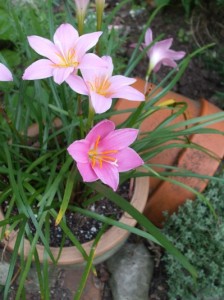
 Rain lilies, which open pink then fade as they age, like to be crowded in the pot. © Jo Ellen Meyers Sharp
There’s something very special about the charming little rain lily (Zephyranthes grandiflora), which makes it a pass-along, or heirloom, in many families. In the recent Old House Gardens Heirloom Bulbs catalog, owner Scott Kunst tells of a Wisconsin family who has had them for more than 100 years
read more»
By Jo Ellen Meyers Sharp, on February 14th, 2009
It’s not too late to pick up a few buds for your best gal or guy to celebrate Valentine’s Day. Roses, tulips or any bouquet of cut flowers will do the job. And, with today’s tight budgets, consider buying just a few flowers instead of dozens.
“Don’t spoil things by saying, ‘I couldn’t afford a dozen,’ ” says Sally Ferguson, who represents the Netherlands Flower Bulb Information Center in Danby, Vt. “One perfect flower is symbolic. It shows you’re deep, get it? If one perfect flower’s symbolic, two are mythic!”
read more»
By Jo Ellen Meyers Sharp, on December 20th, 2008
Two bulbs set the scene during the holidays – amaryllis, with its large trumpet like flowers atop a sturdy stalk, and paperwhites, a very fragrant daffodil that perfumes the room.
 Center stage — Amaryllis growth stages from bulb to flower. (Photos courtesy Netherlands Flower Bulb Information Center)
Amaryllis (Hippeastrum) and paperwhites (Narcissus tazetta) are readily available at garden centers and online and mail order merchants. Buy the biggest bulbs you can find. Here are some more tips:
Amaryllis
- Pot it in a container that is slightly larger than the bulb is wide. Use a high-quality soilless potting mix that drains well. The top half of the bulb should be above the soil line. Water thoroughly. Place the bulb in a warm, sunny window. Allow the soil to go dry between watering.
read more»
By Jo Ellen Meyers Sharp, on October 11th, 2008
 Bloomin’ heart — In spring, these crocuses will bloom in a heart-shaped bouquet of purple, yellow, blue and white blossoms. (Photo courtesy Netherlands Flower Bulb Information Center)
Fall is an ideal time to let kids make lawn art with spring-blooming bulbs. Children can create a design or a message in the grass that will appear next spring. For example, they can spell out a greeting, their name, the address or create a heart or other shape. Here are some tips:
- Early blooming bulbs allow for adequate ripening of the foliage before the grass needs to be mowed. After blooming, the foliage needs to ripen in order to replenish the under ground bulb for the following year’s flowers.
Removing the foliage before it turns yellow, brown or falls flat, will decrease the flowers next year. The ripening process may take up to six weeks. Larger, later-blooming bulbs, such as hybrid tulips (Tulipa) or daffodils (Narcissus), may not have enough time to ripen before the grass needs to be cut. However, if you are willing to sacrifice next year’s flowers for this year’s show, go for the larger bulbs and mow when needed.
read more»
|
|
Most Popular Posts