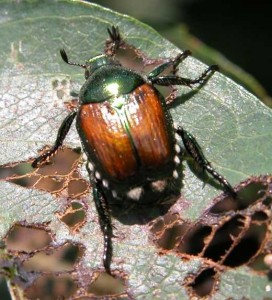
Japanese beetle. Photo courtesy Purdue University
If they are not here yet, they will be soon. Japanese beetles, those somewhat attractive metallic looking insects, will soon be munching on your roses, green beans, hibiscus and dozens of other ornamental plants. On the Hoosier Gardener segment July 1 on Indianapolis’ Fox 59, we talk about these insects and how to control them.
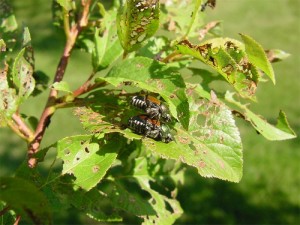 The insects can be quite destructive, skeletonizing leaves and devouring certain flower petals.
How many we will have this year is always a big guessing game. For instance, as my neighbor mentioned, last summer was really dry, which may have made it harder for the adults to lay eggs in the ground, where they become grubs and feed on the roots of grass. The rain this season will not do anything to reduce the emergence of the beetles from the soil, however.
Most pesticides that kill Japanese beetles (Papilio japonica) also kill other insects, including beneficial ones like bees, butterflies, lady beetles and the bugs that like to dine on Japanese beetles.
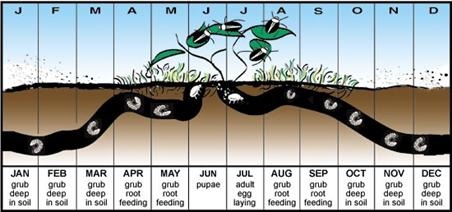
Illustration courtesy University of Minnesota
They are here for a month to six week and to control them, you need to know their life cycle and their habits.
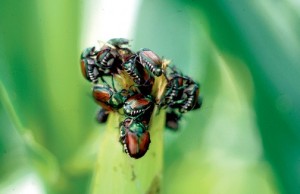
Japanese beetles cluster on tips of corn silk.
Japanese beetles feed in groups. They scout out plants that have several other beetles and join the fray. When we reduce the number of beetles on our plants, we cut down on the tendency to attract group feeds.
- Shake off the beetles onto newspaper, a cloth or plastic sheet. Do this early in the morning when the insects are sluggish. Dump the beetles collected into a bucket of soapy water. Dump the contents of the bucket on the lawn.
- You can also shake the beetles directly into the bucket of soapy water.
- Hand pick the beetles from the plants. Yuk! Some people actually do this. I use the soapy water method, if needed.
- Insecticidal soap will kill the insects on contact, but has no residual effect.
Other tips:
- When selecting plants for the landscape, pick those that have resistance to Japanese beetles. Plants in the rose family, such as roses and hibiscus, seem to take the biggest hits.
- Planting several species of plants in the landscape seems to reduce Japanese beetles. Or maybe plant diversity just makes damage less noticeable.
- Cut down on the use of insecticides. When we reduce the use pesticides, we allow Mother Nature’s predator insects to dine on the Japanese beetles. I hardly have any Japanese beetle damage in my yard and I rarely use insecticides, preferring to let the bugs take care of themselves.
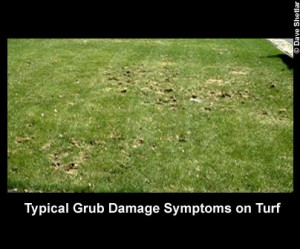

Photo courtesy Ohio State University.
Controlling Japanese beetle grubs in the lawn will not necessarily keep the insects out of your yard. The beetles travel up to five miles for their dinner. Grub damage is usually evident in late summer. It appears as brown patches in the lawn.
- Japanese beetle traps work really, really well. That means they will attract more beetles than those in your yard, possibly increasing the damage the insects do before they reach the trap. The joke is if you are going to use a trap, give it to your neighbor. However, for large properties, placing the traps along the perimeter or on the border of woods may be helpful.
- Some weeds are Japanese beetle faves, too, such as poison ivy and wild grape vines, so keeping these weeds under control will help keep down Japanese beetle populations and food sources. Another favorite, smartweed (Persicaria coccinea) is considered a trap plant and some gardeners will allow two or three of these plants to remain in the yard to collect the beetles.
Homeowners should be aware there is a brand new EPA registered product on the market for protecting gardens from Japanese Beetles, Emerald Ash Borer and as other invasive insects. It just became available in August 2010. The high concentrate, imidicloprid product is called, Optrol. It is the only retail product available that is labeled at the highest rate which is needed for efficacy when treating for these pests. Optrol is a soil drench product which will protect gardens and trees for 12 months and is being sold at independent garden centers and other small retailers through independent representatives. You may be interested to know that Optrol was researched and tested by Purdue University, Michigan State University and Ohio State University (among others) before launch of this product. Find out more here: http://plantcarescience.com/