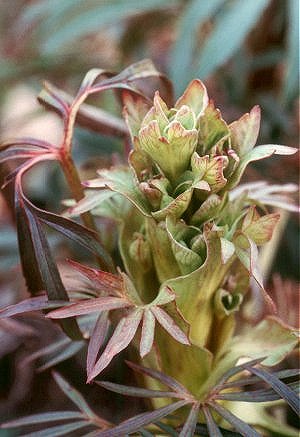
Frenchy bear claw hellebore (Helleborus foetidus). (C) Photo Barry Glick/Sunshine Farm and Gardens
If you have a hellebore (Helleborus), you know what I mean when I say I want more, more, more of these evergreen, shade-loving, drought tolerant, deer resistant, winter blooming perennials.
The vibrant, deep green leaves of the hellebores stand out as other perennials fade for the season. The two most popular types are Christmas rose (H. nigra) and Lenten rose (H. orientalis or H. x hybridus), names that roughly mark their bloom time. Lenten rose was the 2005 Perennial Plant of the Year.
Stinking hellebore (H. foetidus) is not as readily available in garden centers, maybe because of its name, which reflects the musty smell from crushed leaves. Also called bear claw hellebore, it is a hardy, but short-lived perennial that holds its place in the Indiana garden because it readily self sows.
“They self-sow all the time in the garden,” says Irvin Etienne, horticulture display coordinator at the Indianapolis Museum of Art, where you can see several plantings of bear claw hellebores.
“The only way I’ve been able to kill a Helleborus foetidus is to plant it in a wet area,” says Barry Glick, owner of Sunshine Farm and Gardens, a hellebore breeder in West Virginia.
The seed needs to be collected and sown fresh, says Gene Bush, a shade plant expert and owner of Munchkin Nursery in Depauw, Ind. If the seed is allowed to dry out, “it is probably dead. I happen to think direct sow is easiest for the home gardener.”
Bear claw hellebore has finely cut foliage. Showy flowers rise above the plant on light green, 18 to 24 inch stalks in early to mid-winter, blooming in February or March. The frequently fragrant flowers are a pale green with a bit of yellow hue and sometimes, purple or maroon markings.
Bear claw hellebore offers no advantage over any others, Bush says. “Simply different species with entirely different appearance over the other two most well know hybrids on the market.”
That’s a good enough reason for me.