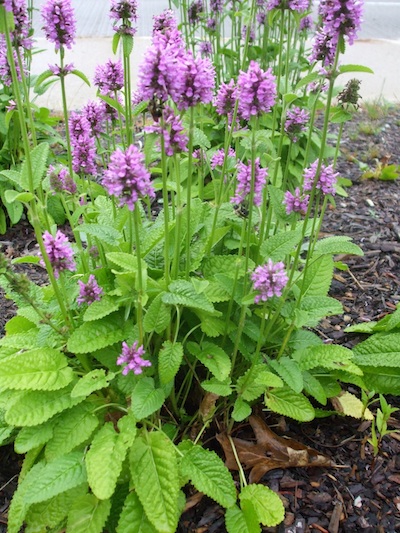
Bet on this — Well-behaved betony ‘Hummelo’ blooms for several weeks in mid-summer. © Photo Jo Ellen Meyers Sharp
Some time ago, a colleague asked me to help identify a perennial in her garden. It had square stems, low-growing leaves and several 12-inch stalks topped with dense, pink-lavender flowers.
It looked a lot like a sage (Salvia) and I scoured resources to confirm, but couldn’t find anything like it. Quite by accident, I came across the plant, Stachys monieri ‘Hummelo,’ also called betony. You may also find it listed as S. officinalis and S. densiflora.
Stachys also is the scientific name for lamb’s ear (S. byzantina). Lamb’s ear is a silvery gray, fuzzy-leafed perennial that spreads rapidly. ‘Hummelo’ has crinkled, fresh-green leaves and grows in a clump.
‘Hummelo’ is quite well behaved, maintaining a tight clump throughout the growing season. In a few years, the clump will get about 18 inches wide.
Sometimes called wood betony or alpine betony, this plant blooms in mid-summer. Removing the spent blooms, called deadheading, can extend this period. It prefers six or more hours of full sun a day. Like all stachys, it needs well-drained soil to thrive. Once established, it is drought tolerant. In fact, it is almost evergreen, retaining its green foliage well into winter. In spring, snip off winter-damaged leaves. Divide in spring every three or four years to remove the woody center.
Appreciated for its texture and form, this plant is hardy throughout most of the Midwest. Use in a border or mass it. A good cut flower, it can be grown in a container for summer enjoyment and transplanted to the garden in fall. It is deer resistant.
‘Hummelo’ got the highest marks in trials at the Chicago Botanic Garden, according to a report issued a few years ago. Good companion plants include coneflower (Echinacea), rattlesnake master or sea holly (Eryngium), Russian sage (Peroviskia), catmint (Nepeta), hardy geranium (Geranium) and stonecrop (Sedum).
‘Hummelo’ may be hard to find, so call your favorite garden center and ask if it is in stock. It also can be found through several Internet retailers.