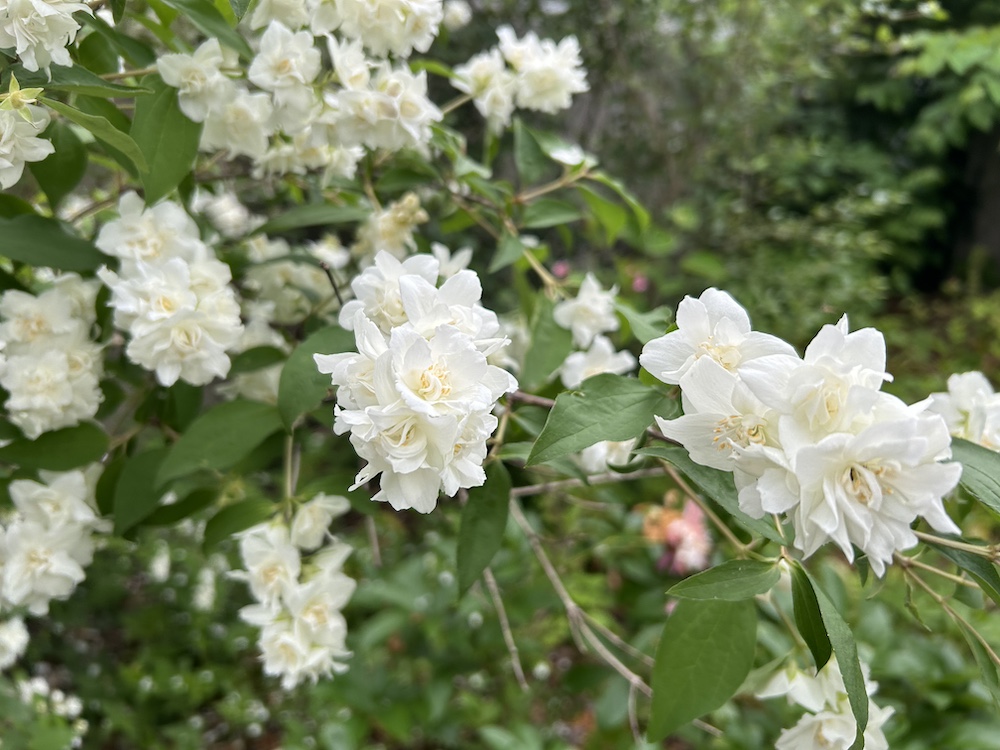
Some plants shout their presence in the garden by their scent.
Soon, an antique mock orange will begin perfuming the back yard, stirring memories of my mother, who loved the flowers, and the friend who gave it to me.
It is called mock orange because its flowers and intense fragrance recall the citrus. The 1-inch-wide flowers are a pure white and can be single or a frilly double with soft yellow stamens.
My friend Linda gave me the double flowering mock orange when I moved here 30 years ago. It came from an old family farm so I’m carrying on a heritage of sorts.
Sometimes called sweet mock orange or English dogwood, this species (Philadelphus coronarius)comes from southern Europe and has naturalized throughout the eastern United States. There are some native North American mock oranges, but most are in the western United States and Mexico.
Mock orange prefers a sunny spot, but does quite well in part shade, which is where mine has been for 30 years. Grow mock orange in well-drained, moist soil rich in organic matter. It blooms on year-old growth, so if pruning is needed, do so right after it blooms or you risk cutting off next year’s flowers.
It ranges from 4 to 10 feet tall, depending on the cultivar. It has a rounded form with cascading branches ladened with clusters of flowers. The species develops a shrubby appearance as it ages, so plant it where its base is softened by companion plants. It also benefits from an occasional rejuvenation pruning, where old branches are removed to encourage new growth.
Leaves turn a pale yellow or stay green before they fall. On older plants, the bark naturally strips off, or exfoliates, to reveal an orangey color for winter interest.An old-fashion shrub, mock orange seems to have fallen out of favor the last several years, probably because of its shrubby looks. There are newer garden-worthy hybrids, though, including ‘Natchez’ and ‘Minnesota Snowflake’ (P. x virginalis), each with fragrant, 2-inch- wide flowers.