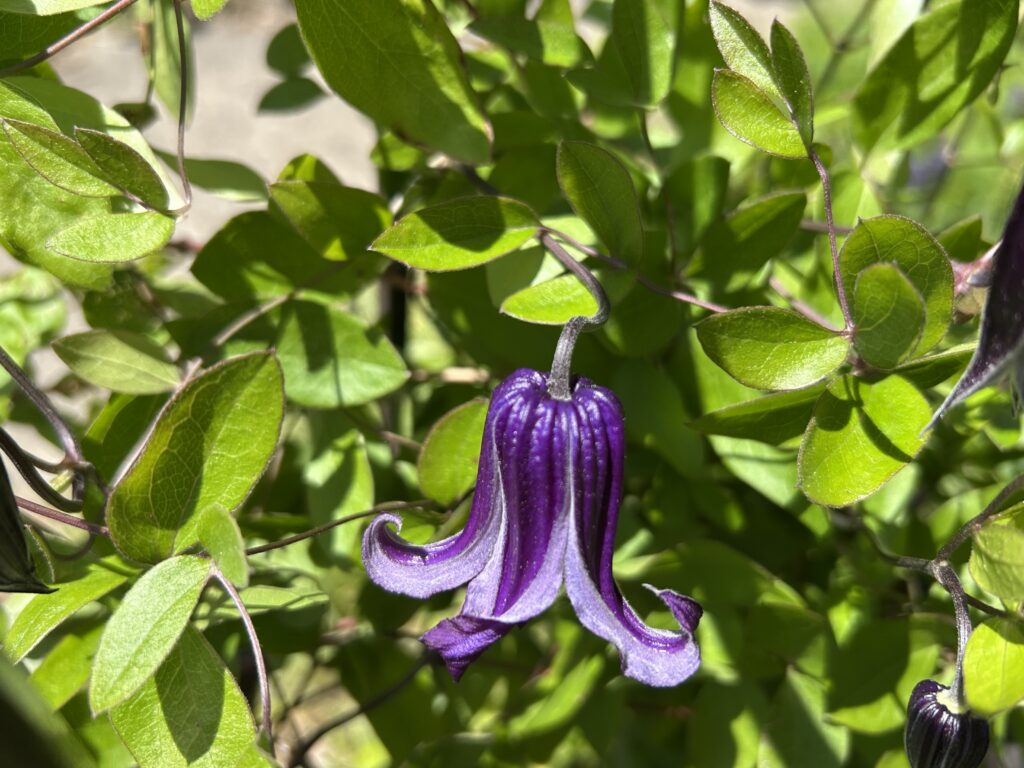
My first experience with Clematis was with Jackmanii, which has beautiful purple flower about 5 inches wide. I’ve had it at both places I’ve lived because of that purple flower.
I’ve stayed with the purple flowers, adding Rooguchi (pictured), Stand by Me, Sapphire Indigo and Clematis integrifola to my landscape.
At least one of the questions about clematis is how to pronounce the name of the vining or trailing, woody perennial.
I learned from Deborah Hardwick with Spring Hill Nursery in Ohio, one of the best experts on this species, that it really doesn’t matter how you pronounce it: clem’-a-tis or cle-ma’-tis.
The Brits and many (most?) horticulturists pronounce it with the accent on the first syllable and those of us with German and Dutch backgrounds put the accent on the middle one. Being of German descent, I feel so much better.
A lot of gardeners think of clematis as vines that have large colorful flowers. But there are other types of clematis, including those with bell-shaped flowers, which right now are my favorites. Some climb and some trail or are bush types.
When to prune
Another common question about clematis is when (or if) you should prune it. There are three classes or groups of clematis when it comes to pruning.
The Missouri Botanical Garden breaks it down like this:
Group 1 – Flowers only on old wood (previous year). Prune after spring flowering.
Group 2 – Flowers on both old and new wood. Typically, little pruning should be done for woody-stemmed members of this group. If cut to the ground or pruned in fall or spring, flowering will be reduced or delayed but not prevented.
Group 3 – Flowers only on new wood. Can be cut to the ground in fall or spring.
Native clematis
Three native clematises grow in Indiana: C. pitcheri, C. virginiana and C. virona. C. pitcheri and C. virona have bell-shaped flowers. C. virginiana is a late summer bloomer with white star-like flowers similar to the invasive sweet autumn clematis (C. terniflora).
How to help clematis climb
Many gardeners have learned they need to attach some type of wire or string fencing around a fence post because the clematis’ petiole isn’t long enough to wrap around a 4- by 4-inch post.
The petiole is the thin green stem that connects leaves and flowers to the plant. It’s usually no longer than 4 inches. At that length, it needs something thin to climb. Clematis can’t handle anything larger than 2-inch diameter for trellising. Remember, it’s the petiole that twines, not the branch.
Read more