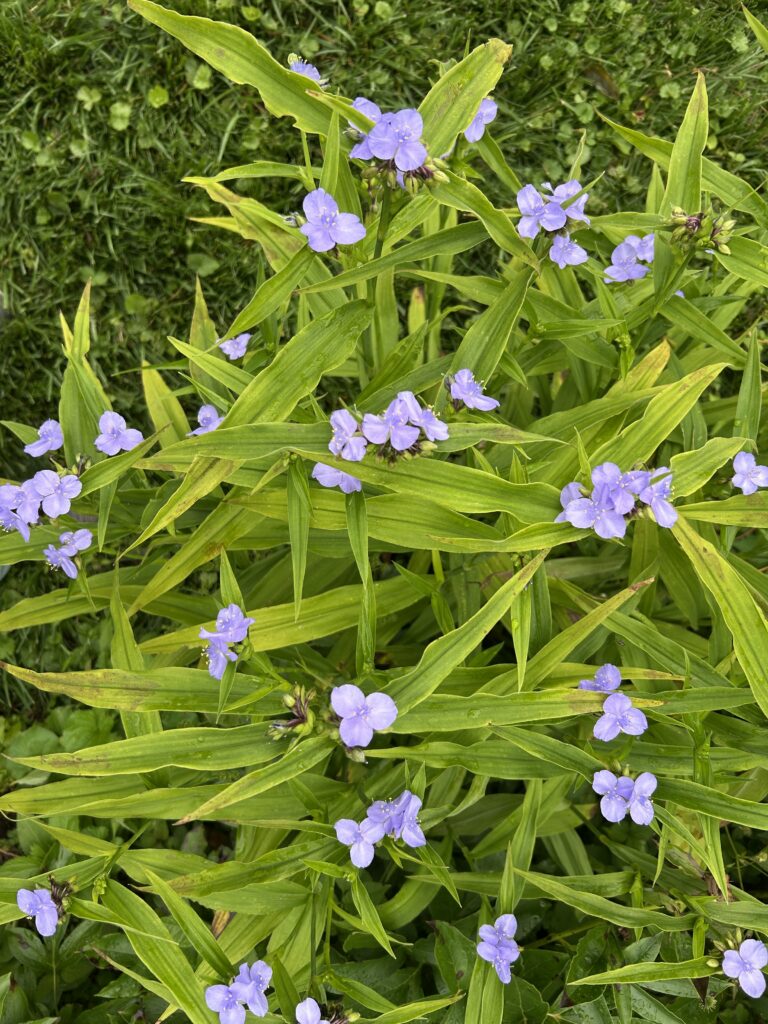
When I was weeding, I started pulling what I thought was Japanese day flower (Commelina communis), which looks similar to spiderwort (Tradescantia spp.) But the closer I looked at the flower, I realized it was not the exotic species.
Rather it was zigzag spiderwort (T. subaspera), an Indiana native perennial and I couldn’t be happier. It took me a while to confirm the species because in general the all sort of look alike.
The one app on my phone that I pay for is Picture This, which told me it was zigzag. I posted photos of this plant on the Indiana Native Plant Society’s Facebook page asked for help in identifying which spiderwort species it is. I knew I was going to write about it so I wanted to make sure I had the correct reference.
After several responses, native plant expert Ellen Jacquart (thanks, Ellen!) settled on zigzag, citing this spiderwort’s distinctive leaf pattern and mid-summer bloom time. The leaves are about 1-inch wide and look gently folded in the middle. This spiderwort does best in shade to part shade.
Zigzag is one of at least three spiderworts native in Indiana. Virginia spiderwort (T. virginiana) blooms May to July and does best in shade to part shade. Think woodland setting. Ohio spiderwort (T. ohiensis), sometimes called bluejacket, blooms May to July in full sun to part shade.
The Native Plant Society’s web site lists places or groups that sell native plants, so that’s a good place to start if you want to add this to your garden. Spiderwort can be planted in spring or fall.
There are cultivars of spiderwort on the market and lot of people are familiar with the tradescantias that are houseplants. And there are some tradescantia available as hardy perennials, such as ‘Sweet Kate’, a member of the Anderson Group, which includes hybrids of native and exotic spiderwort. ‘Sweet Kate’ has yellow leaves and dark blue flowers. Definitely, a stunner in full sun.
Perennial spiderworts, including our native species, can handle wet or moist soils, making them candidates for rain gardens.